

What Features Should You Look for in a Smart Meter? 7 Specifications That Matter
- digital energy meter, Electrical, HPL India, meter
- October 6, 2026
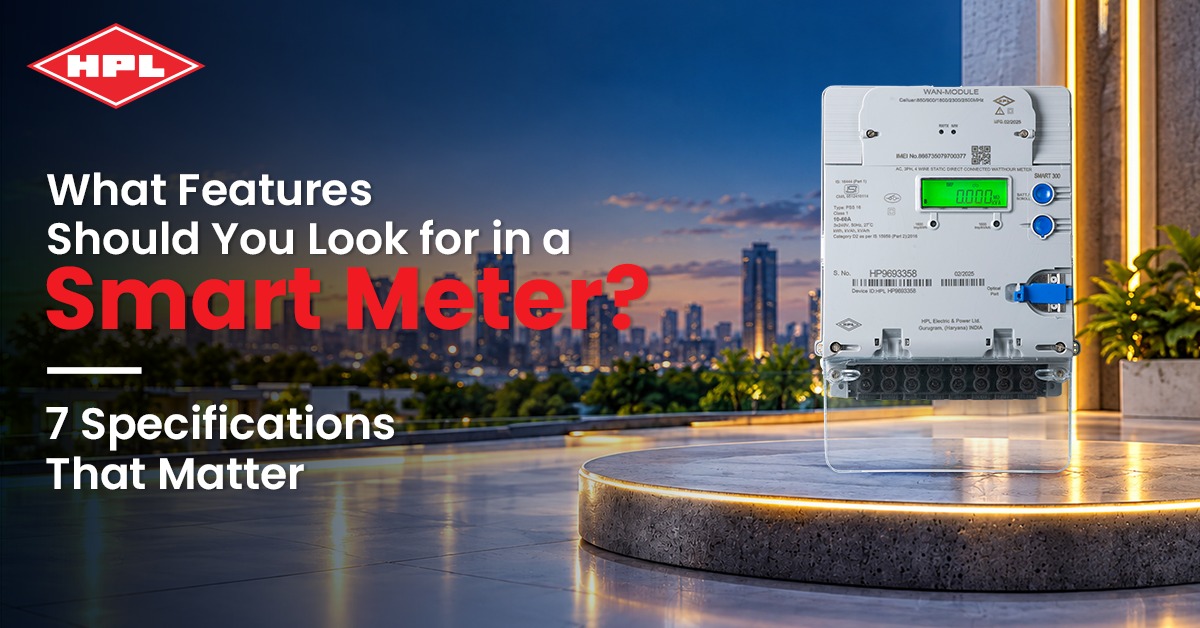
Smart meters are changing the way electricity consumption is measured, monitored and managed. With access to consumption data, time-based readings & remote monitoring, households, businesses and electricity providers can gain a better understanding of how electricity is being used.
Choosing the right smart metering solution, however, starts with understanding its specifications. Accuracy class determines how precisely the meter measures energy, current rating must match the electrical connection and communication capabilities affect how readings reach the monitoring system. Features such as Time-of-Day (TOD), tamper detection and remote configuration also serve specific purposes.
Knowing what these seven specifications mean can help you select a smart meter suited to your electricity requirements.
7 smart meter specifications worth checking before you choose
A good smart meter should measure electricity accurately, match the electrical connection, communicate reliably with the metering system and provide useful information about consumption and supply conditions.
The following seven specifications help you understand what to look for in a meter and why each capability matters:-
1. Accuracy class: How reliably does the meter measure electricity?
A smart meter records electricity consumption in kilowatt-hours (kWh). Its accuracy class indicates the permissible measurement error under specified test conditions. A meter with a lower permissible error can measure energy more precisely within the conditions defined by the applicable standard.
In India, IS 16444 Part 1 covers direct-connected smart meters, while Part 2 covers transformer-operated smart meters. Class 1 and Class 0.5S are among the accuracy classifications used for these meters. Class 1 allows a different measurement error from Class
0.5S, so the appropriate choice depends on the meter type, applicable standard and installation requirements.
Accuracy matters because consumption readings form the basis of energy monitoring and billing data. However, accurate measurement alone cannot guarantee a correct bill. Tariff
settings, billing periods, meter configuration and the utility’s billing process also affect the final amount.
What to check:- Look for the accuracy class, applicable IS standard and whether the meter is direct-connected or CT-operated. A good meter should meet the accuracy requirements of the intended application and the relevant electricity provider
2. Phase and current rating: Does the meter match your electrical connection?
A smart meter must match the electrical supply and the current passing through it. Single-phase connections are common in homes, while three-phase supplies are used in larger residences, commercial buildings & industrial facilities. The correct configuration depends on the sanctioned connection and the expected electrical load.
Common meter configurations include single-phase ratings of 5-30 A and 10-60 A, along with three-phase ratings of 10-60 A, 10-100 A, and 20-100 A. The suitable rating depends on the installation and the meter’s specified operating range.
For direct-connected meters, current passes through the meter’s measuring circuit. In
CT-operated meters, a current transformer (CT) converts a higher primary current into a smaller secondary current, commonly 5 A. The meter must be compatible with the CT ratio and installation for the readings to represent actual energy consumption correctly. LTCT and HTCT configurations serve different current-transformer applications.
What to check:- Confirm the phase, current rating, direct or CT-operated connection and CT ratio where applicable. A suitable meter should match the electrical connection and load requirements without exceeding its specified operating limits
3. Communication: How does the meter send and receive data?
Communication allows a smart meter to exchange readings and commands with a wider metering system. Cellular communication can connect a meter directly to a server – while a low-power radio frequency (LPRF) arrangement may use a data concentrator unit (DCU) to collect readings from multiple meters and forward them to the server.
Two-way communication allows information to travel in both directions. Depending on the system, it can support remote reading, configuration and authorised control. The available functions depend on the meter, communication network and central system.
Reliable communication is particularly important for utilities and large facilities that need access to consumption data without depending entirely on manual meter reading. However, network coverage, signal conditions and system compatibility affect communication performance.
What to check:- Verify the communication technology, network requirements, protocol compatibility, DCU arrangement and remote functions supported by the complete system
4. TOD and demand management: Can you understand when electricity is used?
Time-of-Day (TOD) functionality records energy consumption across configured time periods. The readings help users understand when electricity consumption is higher and can support energy planning when time-based tariffs apply.
For example, a commercial facility may review its consumption during peak tariff periods and shift suitable activities to lower-tariff hours. The actual benefit depends on the tariff structure and the facility’s ability to adjust its electricity use.
Demand measurement and load control are separate capabilities. A meter may record energy consumption over time and depending on its configuration, support a relay for controlling the connected load. An internal latching relay can retain its switching state without requiring continuous power to hold that state.
What to check:- Look for TOD support, configurable time periods, demand measurement capabilities and relay-based control where required. Confirm that the functions match the applicable tariff and metering system
5. Tamper detection and event logs: What can the meter identify?
A smart meter with tamper detection can identify supported conditions that may indicate interference with the meter or affect its measurement. Event logging records detected incidents, while reporting allows the information to reach the metering system when communication is available.
Detection, recording and reporting serve different purposes. Detection identifies a supported event, recording preserves its details and reporting makes the information available for further review. Event records can help utilities investigate unusual activity and understand the circumstances surrounding a reading.
However, a tamper alert is not automatic proof of electricity theft. The meter can identify only the event types supported by its design and configuration.
What to check:- Review the supported tamper events, event-recording capability, time stamping and reporting method. Confirm how alerts are accessed and investigated
6. Power-event monitoring: Can it record supply problems?
Power-event monitoring helps identify certain conditions affecting the electricity supply. Depending on the meter’s capabilities, events may include power outages, low voltage and high voltage.
Recorded event information can help consumers and utilities understand when supply interruptions or voltage conditions occurred. For commercial and industrial facilities, such records may also support an investigation into equipment interruptions or unexpected operating issues.
An event alarm records or reports a condition; it does not correct voltage fluctuations or prevent an outage. Electrical problems may still require investigation by the electricity provider or a qualified electrician.
What to check:- Confirm the types of power events detected, how the meter records them and whether alerts can be accessed remotely through the metering system
7. Remote configuration and net-metering support: Will it suit changing needs?
Over-the-air (OTA) configuration allows authorised parameters to be updated remotely through the metering system. Depending on the meter’s capabilities, configurable settings may include TOD parameters, billing date and time and the integration period used for recording consumption data.
Remote configuration can reduce the need for certain on-site setting changes. However, the available parameters depend on the meter and system and changes must follow the applicable utility and operational requirements. Configuration updates should also be distinguished from firmware upgrades, which involve updating the meter’s software.
For solar installations, net metering involves measuring electricity imported from and exported to the grid. A suitable meter must support the required bidirectional measurement and comply with the applicable utility requirements. A meter’s stated net-metering suitability does not automatically establish compatibility with every solar installation.
What to check:- Confirm the available remote configuration options, authorisation requirements and import-export measurement capabilities. For solar installations, verify the meter’s compatibility with the connection and the electricity provider’s requirements
A quick checklist before selecting a smart meter
Before choosing a model, confirm:-
- Phase, current rating and direct or CT-operated connection
- Accuracy class and applicable standard
- Communication method and system compatibility
- TOD, demand, relay and remote-control requirements
- Supported tamper and power-event logs
- Remote configuration options
- Net-metering requirements, where solar is involved
Residential users may prioritise the correct connection and reliable consumption readings. Commercial and industrial users may need additional demand, CT or monitoring capabilities. Utilities and system integrators must also check communication architecture and compatibility with the wider AMI system.
Why choose HPL smart meters for reliable electricity monitoring?
At HPL, we understand how important accurate electricity measurement, reliable communication and effective monitoring are for homes, businesses and utilities.
Our smart metering solutions offer a range of capabilities, including Class 1 and Class 0.5S accuracy options, single-phase and three-phase configurations, CT-operated variants, two-way communication, TOD functionality, tamper detection, power-event monitoring and remote configuration. These features help address different metering requirements across residential, commercial and industrial applications.
As an established electrical accessories manufacturing company in India, we bring our experience in electrical equipment to smart metering. Explore our smart metering solutions to find the specifications that suit your electricity requirements and make an informed choice.
Enquire Now
Category
Latested Post
- What Features Should You Look for in a Smart Meter? 7 Specifications That Matter
- How Can a Digital Energy Meter Help You Keep Track of Electricity Usage?
- What Makes the Best Switches For Home In India Fire-Resistant? Understanding Flame-Retardant Materials, Arc Control & Indian Safety Standards

- Air Circuit Breaker vs MCCB: Which Is Better for Main Incomers in Large Commercial Buildings?

- How to Choose the Best Modular Switches in India: A Room-by-Room Guide for Your New Home

- Tips to Choose the Best Spike Guard for High-Power & Sensitive Electronic Devices

- How to Ensure Power Continuity During ATS Maintenance Using a Bypass Changeover Switch
- How to Choose the Right Solar LED luminary for Roads, Parks and Commercial Areas

- 7 Ways to Reduce Industrial Energy Costs Using Multifunction Meters

- 6 Critical Roles of a Multifunction Energy Meter in Modern Electrical Systems