
How to Choose the Right Solar LED luminary for Roads, Parks and Commercial Areas
- Electrical, HPL India, LED Floodlights, Solar
- June 2, 2026
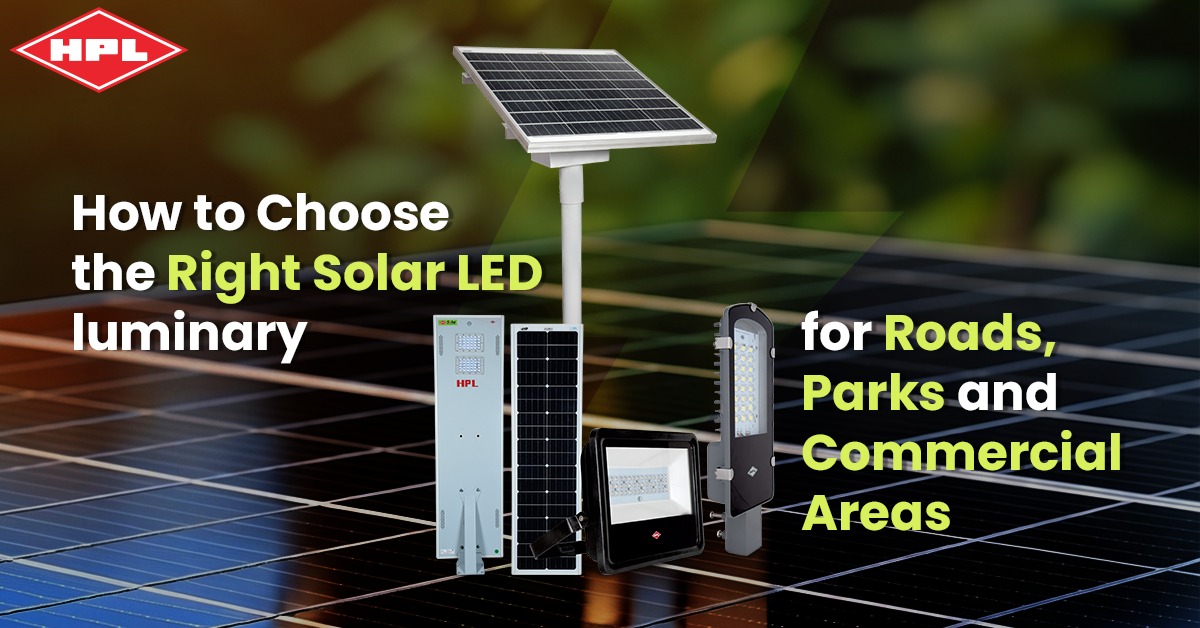
With the rising energy costs and increasing focus on sustainable infrastructure, outdoor lighting projects are rapidly shifting towards solar-powered systems. However, selecting the right solar LED luminary requires much more than comparing wattage or product size. Instead, factors like lumen output, battery backup, panel efficiency, IP rating and lighting distribution influence long-term performance.
Additionally, lighting requirements vary significantly across roads, parks and commercial areas due to different usage patterns, safety expectations and environmental exposure. A lighting system designed for highways may not perform efficiently in landscaped parks or parking zones. Moreover, improper selection often leads to uneven illumination, reduced battery life, excessive maintenance & higher operational costs over time.
Therefore, understanding the technical and practical aspects of solar lighting becomes essential before planning any outdoor lighting installation:-
Understanding Why Different Outdoor Areas Need Different Solar Lighting Configurations
Roads Require Uniform Lighting
Road lighting has to provide visibility without interruption. Highways and city roads usually require typical illumination ranges recommended for outdoor road visibility, while rural roads can work with comparatively lower illumination levels. However, what matters the most is uniform light distribution. A 120W light with poor beam spread can still create dark spots between poles.
For roads:-
- Pole heights generally range from 6-12 metres
- IP65 or IP66 protection is important because of dust, rain and pollution
- Battery backup should ideally support 2-3 cloudy days
- High-efficiency solar panels perform better in locations with inconsistent sunlight exposure or partial shading
One common mistake people make is ignoring beam angle. On highways, narrow beams create tunnel-like visibility – while excessively wide beams waste energy outside the road area. Good road lighting solutions always focus on balanced lux distribution rather than aggressive brightness.
Parks Need Comfort-Oriented Lighting
Parks are different because people walk slowly, sit, exercise and spend time there. Here, harsh lighting actually becomes uncomfortable. Most parks need softer illumination in the range of 10-20 lux.
In real projects, tree coverage becomes a major issue. Solar panels installed under partial shade often charge poorly even when the light appears functional initially. Within months, backup drops drastically.
For proper park lighting design, look for:-
- Diffused optics with anti-glare output
- Motion sensors for pathways with lower activity
- Lower pole heights between 3-5 metres
- Warm or neutral white colour temperature for comfort
This is where smart control systems matter. Motion dimming can reduce battery stress and improve operating life significantly.
Commercial Areas Need Reliability Every Night
Commercial spaces such as office complexes, parking zones and industrial campuses need lighting for safety and surveillance. Even small dark zones increase security risks.
These projects usually require:-
- Illumination levels recommended for commercial outdoor visibility and operational safety
- Higher battery autonomy
- Strong aluminium housing for vandal resistance
- Stable performance during long operating hours
In many industrial sites, dust accumulation reduces solar charging efficiency by 15-25% over time if panels are not cleaned regularly. Good commercial outdoor lighting planning always includes maintenance access along with installation.
Technical Factors That Directly Affect Solar LED Luminary Performance
A lot of people still compare solar lights only by wattage. That approach creates expensive problems later.
Here’s what actually matters:-
- Lumen output: Determines usable A better optical system can provide higher visibility even at lower wattage
- Battery type: Battery quality & charging efficiency directly influence backup duration & long-term system reliability
- Charging autonomy: Good systems should support at least 8-12 hours of nightly operation
- IP rating: IP65 is usually the minimum for reliable outdoor solar lighting systems
- Temperature tolerance: In Indian summers, surface temperatures can cross 45°C. Poor thermal management reduces LED lifespan quickly
Another overlooked factor is lifecycle cost. A cheaper light with frequent battery replacement often becomes more expensive within 3-4 years.
How to Evaluate the Right Solar Lighting System Before Installation
Before finalising any solar lighting setup, ask these five questions:-
- How many hours will the light operate daily?
- Is the area exposed to dust, rain or partial shading?
- What lux level is actually required?
- How many cloudy-day backups are needed?
- Is long-term maintenance realistically possible at the site?
These questions prevent most selection mistakes.
Choosing the Right Solar LED Luminary for Long-Term Performance
Selecting the right solar LED luminary requires a practical understanding of performance, durability & application-specific lighting needs. From roads and parks to commercial spaces, every environment demands a different balance of illumination, battery backup, optics and weather resistance.
At HPL, we understand these requirements through decades of experience in electrical infrastructure and energy-efficient technologies. While many recognize us among trusted smart meter manufacturers in India, our expertise extends across integrated electrical and lighting solutions designed for long-term reliability, operational efficiency and brilliant performance in environmental conditions .
Explore our advanced solar lighting and electrical solutions to build safer, smarter & more energy-efficient outdoor spaces.
FAQs
- What is the ideal battery backup for a solar LED luminary?
For roads and commercial areas, experts usually recommend 2-3 autonomy days. This helps the system operate properly even during cloudy weather or monsoon conditions. - How do integrated electrical components improve outdoor lighting reliability?
Reliable outdoor lighting depends on quality electrical components like modular switches and sockets, protection systems and controllers that support safe, stable and efficient performance. - Why do some solar lights become dim after a few months?
This usually happens because of poor battery quality, insufficient charging due to shading, dust accumulation on panels or incorrect lumen planning during installation.
Enquire Now
Category
Latested Post
- What Features Should You Look for in a Smart Meter? 7 Specifications That Matter
- How Can a Digital Energy Meter Help You Keep Track of Electricity Usage?
- What Makes the Best Switches For Home In India Fire-Resistant? Understanding Flame-Retardant Materials, Arc Control & Indian Safety Standards
- Air Circuit Breaker vs MCCB: Which Is Better for Main Incomers in Large Commercial Buildings?

- How to Choose the Best Modular Switches in India: A Room-by-Room Guide for Your New Home
- Tips to Choose the Best Spike Guard for High-Power & Sensitive Electronic Devices

- How to Ensure Power Continuity During ATS Maintenance Using a Bypass Changeover Switch
- How to Choose the Right Solar LED luminary for Roads, Parks and Commercial Areas
- 7 Ways to Reduce Industrial Energy Costs Using Multifunction Meters
- 6 Critical Roles of a Multifunction Energy Meter in Modern Electrical Systems