

How to Ensure Power Continuity During ATS Maintenance Using a Bypass Changeover Switch
- Automatic transfer Switch (ATS) / Manual Changeovers, Electrical, HPL India
- June 3, 2026
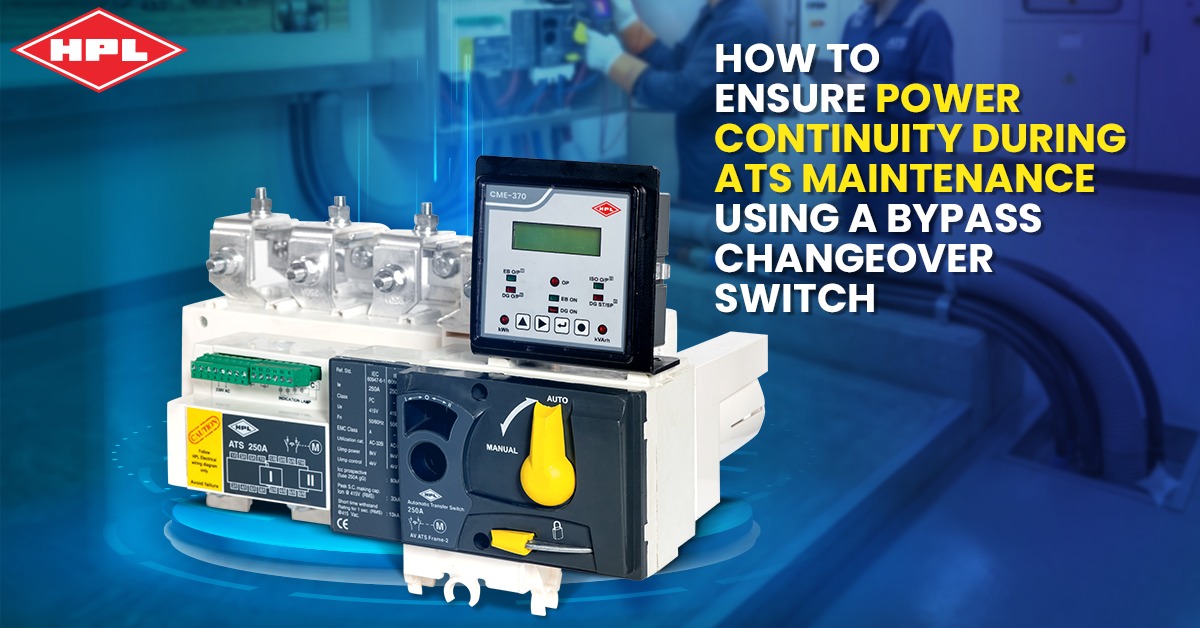
In facilities where uninterrupted power is critical, most systems are designed with backup sources & automatic transfer mechanisms in place. However, one situation that is often underestimated is ATS maintenance. The moment the ATS is taken out of operation, the system temporarily loses its ability to manage power transfer between sources.
This creates a vulnerable window. If a power interruption occurs during this time, there is no automatic response mechanism to shift the load which can lead to unexpected downtime, operational disruption or even safety risks in critical environments.
To address this gap, electrical systems are designed with a bypass changeover switch – allowing power to be routed independently of the ATS. This ensures that maintenance activities can be carried out without interrupting supply, while maintaining full control over the load transfer.
Why ATS Maintenance Can Become a System Risk
An Automatic Transfer Switch (ATS) is a central control point in any dual power system. It manages the transition between primary and backup sources – ensuring continuity without manual intervention. Because of this role, the system’s reliability is closely tied to the ATS being operational at all times.
Now think about this:
- During maintenance, the ATS has to be shut down
- That means no automatic switching
- And in many setups, no alternate switching path either This creates a situation where:
- Any unexpected power failure during this window cannot be managed automatically
- Manual switching introduces delays and increases the possibility of human error
- Even a short interruption can impact connected loads
The impact becomes more serious in environments where power continuity is directly linked to operations:-
- In healthcare facilities, interruptions can affect critical equipment
- In factories, a sudden outage can halt production lines and lead to material losses
- In commercial buildings, it affects operations, lifts, HVAC, everything
The key issue here is not the absence of backup power but the absence of a reliable switching mechanism during maintenance. Without a planned alternative, ATS maintenance effectively creates a temporary vulnerability in an otherwise stable system.
What a Bypass Changeover Switch Does
Normally, the power flow looks like this:
- Power source to ATS to Load
When a bypass system is introduced, another route is created:
- Power source to Bypass to Load So during maintenance:
- The load is shifted to the bypass
- The ATS is completely isolated
- Power keeps running without interruption
The importance of this arrangement lies in controlled continuity. The system does not rely on temporary fixes or manual improvisation. Instead, it follows a defined switching path that maintains supply while ensuring that the ATS can be handled safely.
How to Ensure Continuity
1. Prepare before touching the ATS
You don’t just shut things down and start working.
- Check load conditions
- Ensure a stable power source is available (grid or generator)
- Confirm that the bypass path is functional
2. Shift the load to bypass
Now you engage the bypass changeover switch.
- Power is rerouted directly to the load
- ATS is no longer carrying any load
At this stage, your system is running but through a different path.
3. Isolate the ATS safely
Now the ATS can be:
- Inspected
- Serviced
- Repaired
Without any live load running through it. This reduces:
- Risk of electrical faults
- Risk to maintenance teams
4. Bring the system back
Once maintenance is done:
- ATS is reconnected
- Load is transferred back
- System returns to automatic mode
Where this setup becomes absolutely necessary
Some setups can survive short outages. Others simply cannot. Bypass-integrated systems are critical in:
- Hospitals and healthcare setups
- Data centers handling real-time operations
- Manufacturing plants running continuous processes
- Large commercial buildings with high dependency on power
In such cases, the cost of downtime is far higher than the cost of proper switching infrastructure.
This is why modern electrical planning focuses not just on backup power but on ensuring uninterrupted power continuity under all conditions including maintenance.
Things People Often Overlook
These are the things that people often overlook but shouldn’t:-.
- Proper interlocking is required to avoid dual supply issues
- The switch must be rated correctly for the load
- Operators should clearly understand the switching sequence
- The system should be designed, not patched later
A poorly handled bypass can create more problems than it solves.
When selecting switching systems, professionals usually prefer trusted private electrical companies in India that focus on performance and safety. At HPL, we design our solutions to handle such challenges, ensuring reliable operation even during maintenance.
It’s not just a backup. It’s continuity planning
Having a generator is not enough. Having an ATS is also not enough.
Real reliability comes from planning for situations where even your switching system is unavailable.
A well-designed bypass setup ensures that:
- Maintenance does not mean downtime
- Operations continue without interruption
- Risks are controlled, not reacted to
HPL is proud to be a leader among the top 10 electrical companies in India, focusing on building practical, ground-level solutions where safety, continuity, and real-world usage converge.
FAQs
- Can ATS maintenance be done without shutting down power?
Yes, but only if a proper bypass system is installed. Without it, maintenance usually requires interruption or risky manual handling. - Is a bypass changeover switch necessary for small setups?Not always. It becomes important where power interruption can cause financial loss, safety risks or operational disruption.
- What is the biggest mistake in using bypass systems?Improper switching sequence and lack of interlocking. This can lead to dual supply faults or equipment damage if not handled correctly.
Enquire Now
Category
Latested Post
- What Features Should You Look for in a Smart Meter? 7 Specifications That Matter

- How Can a Digital Energy Meter Help You Keep Track of Electricity Usage?

- What Makes the Best Switches For Home In India Fire-Resistant? Understanding Flame-Retardant Materials, Arc Control & Indian Safety Standards

- Air Circuit Breaker vs MCCB: Which Is Better for Main Incomers in Large Commercial Buildings?

- How to Choose the Best Modular Switches in India: A Room-by-Room Guide for Your New Home

- Tips to Choose the Best Spike Guard for High-Power & Sensitive Electronic Devices

- How to Ensure Power Continuity During ATS Maintenance Using a Bypass Changeover Switch
- How to Choose the Right Solar LED luminary for Roads, Parks and Commercial Areas

- 7 Ways to Reduce Industrial Energy Costs Using Multifunction Meters

- 6 Critical Roles of a Multifunction Energy Meter in Modern Electrical Systems