
Air Circuit Breaker vs MCCB: Which Is Better for Main Incomers in Large Commercial Buildings?
- Circuit, Electrical, HPL India, Switchgears
- August 18, 2026
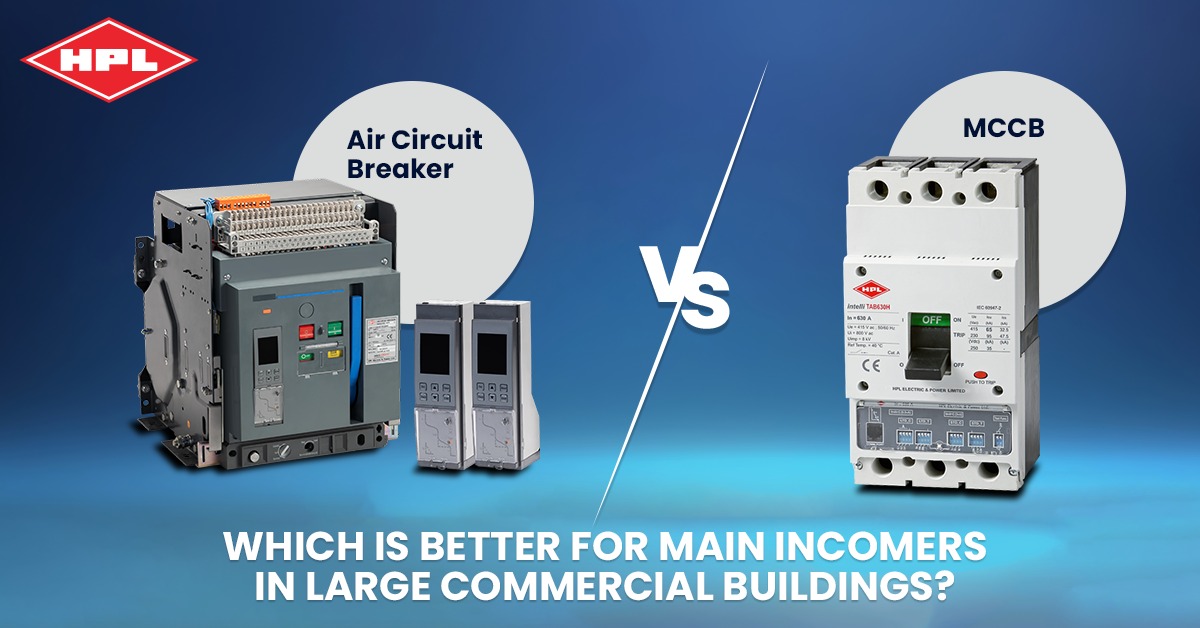
Choosing between an Air Circuit Breaker and an MCCB for the main incomer of a large commercial building is a critical engineering decision. In malls, hospitals, hotels, IT parks, airports & high-rise offices, the incomer breaker protects the entire low-voltage distribution system and influences safety, reliability and downtime. Moreover, selecting the wrong breaker can affect short circuit protection, coordination with downstream feeders, maintenance safety and future load expansion.
Therefore, the decision should not be based on current rating alone. Instead, engineers must evaluate fault level, number of feeders, continuity requirements, selectivity and long-term operation. Accordingly, this article explains the practical differences between ACBs and MCCBs and helps identify which option is technically better for large commercial buildings:-
Why the Main Incomer Is the Most Critical Breaker in a Commercial Building
In a typical commercial building electrical system, power first enters through the transformer & then passes through the main incomer breaker before reaching the main busbar. From the busbar, electricity is distributed to major building loads such as HVAC systems, lighting panels, UPS systems, fire pumps, elevators and retail or tenant feeders.
Common main incomer arrangements:-
Large commercial facilities are usually designed with different incomer arrangements depending on the required level of reliability and continuity. Common configurations include:-
- single incomer for relatively simpler installations
- dual incomers supplied by two transformers for higher reliability
- bus coupler arrangements that connect two bus sections and allow power transfer during maintenance or faults
Typical incomer ratings in commercial buildings:-
- 400 A to 630 A in smaller commercial buildings
- 800 A to 1250 A in medium-sized complexes
- 1600 A to 4000 A or higher in malls, hospitals, IT parks, airports and other large facilities
For main incomers, fault level and continuity of supply are usually more important than the initial breaker cost. A lower-cost breaker that trips the entire building during a downstream feeder fault
can ultimately create much higher costs through downtime, loss of operations, equipment disruption and maintenance intervention.
Understanding MCCB for Main Incomer Applications
An MCCB is a molded-case breaker with thermal-magnetic or electronic protection. It is compact, economical and widely used in low voltage switchgear systems. small and medium commercial buildings
Where MCCBs perform best:-
- 400-1250 A systems
- moderate fault levels
- installations with a limited number of feeders
Key advantages of MCCBs:-
- compact size
- lower panel space
- lower upfront cost
- reliable protection for simpler systems
Limitations for large incomers:-
- limited short-time withstand capability
- less flexibility in selectivity
- no draw-out isolation
- more difficult maintenance in live panels
- limited advanced monitoring integration
An MCCB is not an inferior breaker. It is often the correct choice when the distribution system is relatively simple. In many Indian commercial projects, consultants may use MCCBs for feeder circuits while selecting larger devices for the main incomer
Understanding Air Circuit Breakers for Main Incomers
An Air Circuit Breaker uses air as the arc-quenching medium & is usually built in a draw-out construction. This allows the breaker to be isolated, tested and replaced more safely.
Features that matter in large buildings:-
- adjustable long-time, short-time, instantaneous and ground-fault protection
- zone Selective Interlocking (ZSI)
- remote operation
- event logging
- BMS/SCADA integration
- easier testing and maintenance
Typical commercial ratings:-
- 800 A to 6300 A
- 50 kA to 100 kA breaking capacity
ACBs are generally selected where continuity, selectivity, maintainability and future scalability become critical
Air Circuit Breaker vs MCCB: The 10 Differences That Matter
Parameter | MCCB | ACB |
Current capacity | commonly up to 1250–1600 A | 800 A to 6300 A+ |
Best use | feeders and smaller incomers | main incomers and bus couplers |
Short-circuit handling | good | better for high fault levels |
Selectivity with downstream breakers | moderate | high and more adjustable |
Draw-out isolation | no | yes |
Maintenance | more shutdown-oriented | easier and safer |
SCADA/BMS integration | basic or optional | advanced monitoring available |
Future expansion | limited | better suited for load growth |
Initial cost | lower | higher |
Main incomer suitability for large commercial buildings | suitable in simpler systems | generally preferred |
Which Breaker Do Different Commercial Buildings Need?
Shopping malls
Typically use 1500-4000 A incomers with many feeders and very low tolerance for blackout. ACBs are usually preferred
Hospitals
Need coordination between UPS, DG and normal power. Selectivity is critical, so ACBs are strongly preferred
IT parks and data infrastructure
Require redundancy, monitoring and future expansion. ACBs are commonly selected
High-rise office towers
Elevators, HVAC & tenant loads grow over time. ACBs are often preferred above 1600 A
Hotels
Operate 24×7 and maintenance without shutting down guests is a major advantage of draw-out ACBs. As building complexity increases, the value of selectivity and maintainability rises much faster than the value of lower initial cost
Fault Level: The Most Ignored Selection Factor
Consider a 1600 kVA transformer. Depending on transformer impedance, the prospective short-circuit current at the LT bus can exceed 35-40 kA.
Parameters that must be checked:-
- Icu – ultimate breaking capacity
- Ics – service breaking capacity
- Short-time withstand capability
A breaker that can interrupt a fault is not automatically a breaker that can coordinate properly with downstream devices
Selectivity: The Real Reason ACBs Win in Large Systems
Imagine this arrangement:-
- 2500 A ACB incomer
- 630 A MCCB feeder
- 250 A MCCB sub-feeder
If a fault occurs on the 250 A circuit, the 250 A breaker should trip first. If the 2500 A incomer trips instead – the entire building loses power. This is why engineers spend time on time-current coordination & discrimination studies. In large commercial buildings, nuisance tripping of the main incomer is often more costly than the fault itself
Maintenance, Downtime and Life-Cycle Cost
MCCBs are usually fixed devices. Replacing or testing them may require a longer shutdown.
Advantages of ACBs during maintenance:-
- draw-out isolation
- easier testing
- lower arc-flash exposure during maintenance
- faster replacement
MCCBs may save 20-40% initially in some installations but ACBs can reduce maintenance and expansion costs over 15-25 years
Final Verdict: Which Is Better?
For most large commercial buildings, an Air Circuit Breaker is generally the preferred choice for main incomers because it offers better fault handling, selectivity, maintenance safety & future scalability. However, the right selection should always be based on transformer capacity,
fault-current study, load profile, continuity requirements and long-term expansion plans.
At HPL, we believe electrical protection should be viewed as a complete distribution ecosystem, not as an isolated product. With decades of expertise in low-voltage switchgear, metering, protection and distribution solutions, we have become one of the most trusted names in the industry. Our integrated portfolio includes ACBs, MCCBs, energy management solutions, products from leading Mcb manufacturers in India & high-quality modular switches and sockets, helping engineers, consultants and facility teams build safer, more reliable and
future-ready commercial electrical systems.
Enquire Now
Category
Latested Post
- What Features Should You Look for in a Smart Meter? 7 Specifications That Matter

- How Can a Digital Energy Meter Help You Keep Track of Electricity Usage?

- What Makes the Best Switches For Home In India Fire-Resistant? Understanding Flame-Retardant Materials, Arc Control & Indian Safety Standards

- Air Circuit Breaker vs MCCB: Which Is Better for Main Incomers in Large Commercial Buildings?
- How to Choose the Best Modular Switches in India: A Room-by-Room Guide for Your New Home

- Tips to Choose the Best Spike Guard for High-Power & Sensitive Electronic Devices

- How to Ensure Power Continuity During ATS Maintenance Using a Bypass Changeover Switch
- How to Choose the Right Solar LED luminary for Roads, Parks and Commercial Areas

- 7 Ways to Reduce Industrial Energy Costs Using Multifunction Meters

- 6 Critical Roles of a Multifunction Energy Meter in Modern Electrical Systems