
How Can a Digital Energy Meter Help You Keep Track of Electricity Usage?
- digital energy meter, Electrical, HPL India, meter
- September 18, 2026
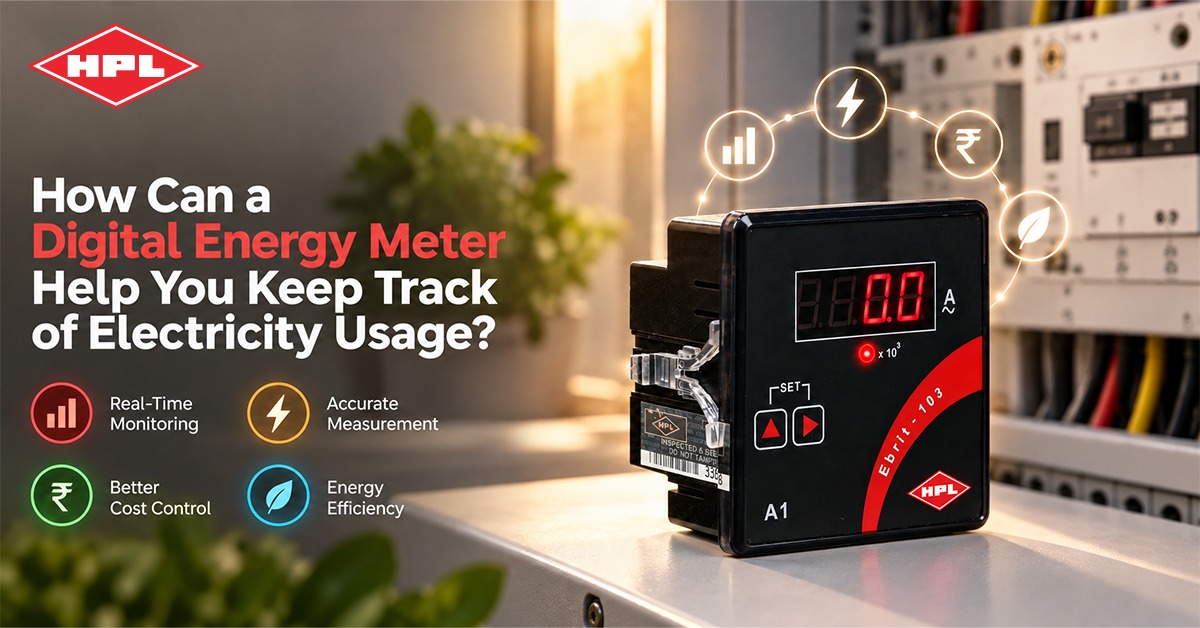
Electricity consumption is often understood only through the final bill, which shows the energy used during a billing period – but offers limited visibility into how that consumption changed over time.
A digital energy meter provides a more direct way to monitor electricity usage by recording energy consumption in kilowatt-hours (kWh). Regularly noting and comparing these readings can help households, businesses and industrial users understand consumption patterns, identify unusual changes and make better-informed decisions about energy use.
To understand how this monitoring works, it is important to first know what a digital energy meter measures and what its readings actually mean:-
What does a digital energy meter measure
A digital energy meter measures electrical energy consumption & displays the reading in units such as kilowatt-hours (kWh). Understanding the difference between ‘kW’ and ‘kWh’ is important when tracking electricity use
Difference between kW & kWh:-
kW (kilowatt) describes the rate at which electrical power is being used – while kWh (kilowatt-hour) describes the amount of energy consumed over a period.
For example, a 2 kW load operating continuously for 3 hours would consume:-2 kW × 3 hours = 6 kWh
Here, 6 kWh represents the energy consumed during those three hours. In everyday electricity billing – 1 kWh is commonly referred to as one unit of electricity.
A meter may show a cumulative reading rather than the consumption for a single day. Suppose the reading was 12,450 kWh at the beginning of a monitoring period and 12,780 kWh later:-
12,780 − 12,450 = 330 kWh
The installation has therefore recorded 330 kWh of energy consumption between those two readings. Commercial and industrial installations can involve CT-operated metering and other configurations, so the applicable meter and installation arrangement should always be considered when interpreting readings.
How can a digital energy meter help you monitor electricity consumption
One meter reading gives you a point of reference. A series of readings starts telling you a story about electricity consumption.
A simple record can look like this:-
Monitoring period | Meter reading | Consumption during period |
Start of Week 1 | 5,100 kWh | — |
Start of Week 2 | 5,170 kWh | 70 kWh |
Start of Week 3 | 5,265 kWh | 95 kWh |
The second week used 25 kWh more than the first. The meter has identified a change but it has not identified the reason for it. That distinction matters.
A user can then look at what changed during that period:-
- Did air-conditioning run for longer?
- Were operating hours extended?
- Was new equipment added?
- Did a pump, motor or refrigeration system operate more frequently?
- Were lights or equipment left running outside normal hours?
- Did production or occupancy increase?
Recording the date, time, meter reading and major changes in operating conditions makes these comparisons much more useful.
Comparisons should also be made between similar periods. A summer month with heavy
air-conditioning use should not be treated as directly equivalent to a cooler month. Similarly, a factory’s electricity consumption can naturally rise when production hours or output increase.
This approach can help establish a consumption baseline – a reference level against which future readings can be compared.
Can a digital energy meter tell which appliance uses the most electricity
A main meter generally measures the total energy passing through its measurement point. Someone who needs to compare individual areas or loads may need appropriate sub-metering.
Separate measurement can be useful for areas such as:-
- Lighting
- HVAC systems
- Production equipment
- Common areas
- Individual sections of a commercial or industrial facility
A main meter can therefore show that total consumption has changed, while additional measurement may be needed to establish which load contributed to the change.
How can meter readings support better energy management
The useful part of energy monitoring begins when the information leads to an informed action.
Consider a shop that normally records around 18 kWh during a working day. Readings begin showing 23-24 kWh even though opening hours and business activity have remained broadly similar. The owner can review equipment operating hours, air-conditioning use and other major loads to find a possible reason.
After making an appropriate change, further meter readings can show whether consumption has moved closer to its earlier level.
The basic cycle is:-
Record – Compare – Notice a change – Investigate – Act – Measure again
A digital energy meter does not reduce electricity consumption by itself. Its role is to provide measurement that helps people understand what is happening and make better decisions based on evidence.
What should you Check before choosing a digital energy meter
Not every digital energy meter provides the same measurements or is intended for the same electrical installation. Selection should therefore begin with the monitoring requirement.
Important points include:-
- Electrical system – check whether the application is single-phase or three-phase and whether the meter suits the system
- Load and current – the expected load determines the appropriate current measurement arrangement
- Direct or CT-operated metering – larger commercial and industrial applications may use current transformers (CTs) to measure higher currents
- Parameters required – decide whether basic energy measurement is sufficient or whether additional electrical parameters are needed
- Communication – applications requiring connection with a monitoring or data system may need a meter with an appropriate communication interface
- Accuracy – measurement accuracy matters when consumption data is being used for comparison, monitoring or energy management
At HPL, our industrial digital energy meter range includes CT-operated models designed for applications such as industrial LT panels, motor control centres, air-conditioning and refrigeration panels and genset panels. Our selected models also provide RS-485 communication, while CT-2EMG models support separate active-energy measurement for mains and generator sources. Features vary across models, so the meter should be selected according to the actual application rather than assuming that every digital meter offers the same capabilities.
Choose HPL for smarter, more reliable electrical solutions
Reliable energy management starts with dependable electrical equipment. At HPL, we bring decades of experience in electrical and energy-management solutions, backed by a broad portfolio designed for residential, commercial and industrial applications.
Our expertise extends across metering, protection, distribution and energy solutions helping customers choose equipment suited to their actual electrical requirements. As one of the established electrical equipment companies in India, we focus on reliable engineering, relevant technology and solutions built around real-world applications.
Our portfolio also includes solar LED luminary solutions, alongside advanced metering and other electrical products. For customers looking for a trusted partner for electrical equipment, HPL combines product breadth, technical understanding and application-focused solutions under one trusted name. Explore our range to find the right solution for your electrical requirements.
Enquire Now
Category
Latested Post
- How Can a Digital Energy Meter Help You Keep Track of Electricity Usage?
- What Makes the Best Switches For Home In India Fire-Resistant? Understanding Flame-Retardant Materials, Arc Control & Indian Safety Standards

- Air Circuit Breaker vs MCCB: Which Is Better for Main Incomers in Large Commercial Buildings?

- How to Choose the Best Modular Switches in India: A Room-by-Room Guide for Your New Home

- Tips to Choose the Best Spike Guard for High-Power & Sensitive Electronic Devices

- How to Ensure Power Continuity During ATS Maintenance Using a Bypass Changeover Switch
- How to Choose the Right Solar LED luminary for Roads, Parks and Commercial Areas

- 7 Ways to Reduce Industrial Energy Costs Using Multifunction Meters

- 6 Critical Roles of a Multifunction Energy Meter in Modern Electrical Systems

- Practical Surge Protection Checklist for Home Electronics